
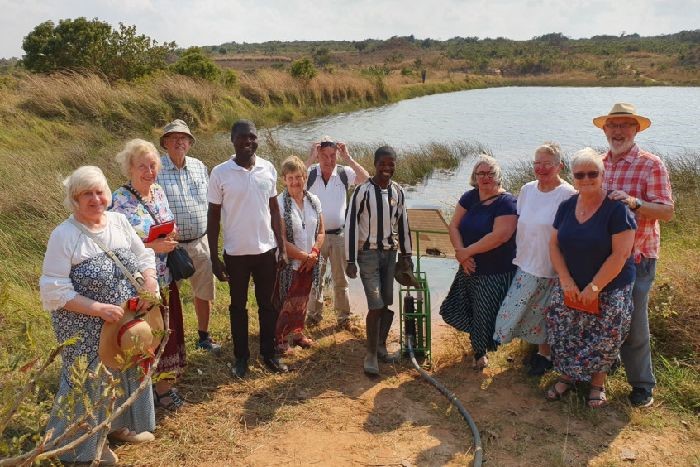
 Iain Whyte, secretary of the Church of Scotland’s Guild, and Karen Gillon, associate secretary, were in Malawi with a small team of Guild members, to strengthen the already vibrant partnerships between the church and the Church of Central Africa Presbyterian (CCAP).
The link between the Church of Scotland and Malawi dates back to 1875, when the first Scottish missionaries, led by Dr Robert Laws from Aberdeen, travelled to Lake Malawi. Malaria killed many of the young Scots, so – armed only with their faith, and travelling in ox carts – they moved twice along the lake shore before finding a healthy haven in a plateau 3,000 feet above Lake Malawi. Here, Dr Laws and his team built Livingstonia, a self-sufficient community. It boasted a church and a post office complete with clock tower, There was a school, a technical college and a hospital. Laws even introduced a hydro-electric supply to power the community.
Livingstonia still stands today, a testament to the bond between Scotland and Malawi. It is now home to one of the country’s newest universities, which specialises in theology, education and applied sciences.
Guild members support a range of projects in Malawi, from a maize mill at Bandawe, the site of Dr Laws’ second mission before he moved to Livingstonia, to a tailoring shop which makes uniforms for the Malawi women’s’ guild.
Karen was particularly impressed by the irrigation scheme the Guild supports in the Rumphi district. Malawi Fruits, another Scottish charity, provides small-holder farmers with solar pumps so that they water their crops regularly.
“It means that instead of one crop a year, they can get two, or even three,” explains Karen, shouting over the horn of an impatient driver, desperate to overtake on us on a blind corner. “That means farmers can grow produce to sell for food processing, instead of just trading by the side of the road. They can even charge their phone on the pump,” she grins.
Her colleague, the Guild’s general secretary, Iain Whyte, believes the church in Scotland has a lot to learn from its sister church. “Most people in Malawi live in villages, and it can be quite a trek to get to church on a Sunday. The CCAP have prayer houses in the community, where three Sundays every month people gather for a service. Then once a month everyone comes together in church for Holy Communion. “Malawi has empowered lay people to preach. We do a little of that at home, but Malawi has shown us that we could do so much more. Bring the church to the people.”
As we approached Blantyre, where Karen was going to spend the weekend with Wilson, Aubrey and Norman, the teenage boys she first met in 2005 as toddlers in the Open Arms orphanage, I asked if Malawi had changed her.
She turned round in her seat. “You can’t be involved in the Scotland-Malawi relationship and not be changed. I have just spent a week on the lakeshore, where the Scots who tried to live there had to move in 1894 because they were dying from malaria. Yet in 2019, thousands of Malawians every year still die from a disease that should be curable.
“I suppose it has made me more determined than ever to do what I can to reduce inequality. And we can all do something, through our churches, community groups, yes even politics.” She laughs, loudly. “Politics has a terrible reputation just now, and rightly so, but if we could get away from the tribal politics, in Scotland as well as Malawi, and focus on what really matters, the world would be a better place.” Amen sister.
Extract from Susan Dalgety’s articel in The Scotsman 17th August 2019.